The short version
- It's a generic template. If your SWMS could be handed in on any site in the state, it fails.
- Nothing in it says which site. Reviewers look for the area, the plant and their own site rules.
- The controls have no "how". PPE listed first, nobody named to check it, no record the crew was consulted.
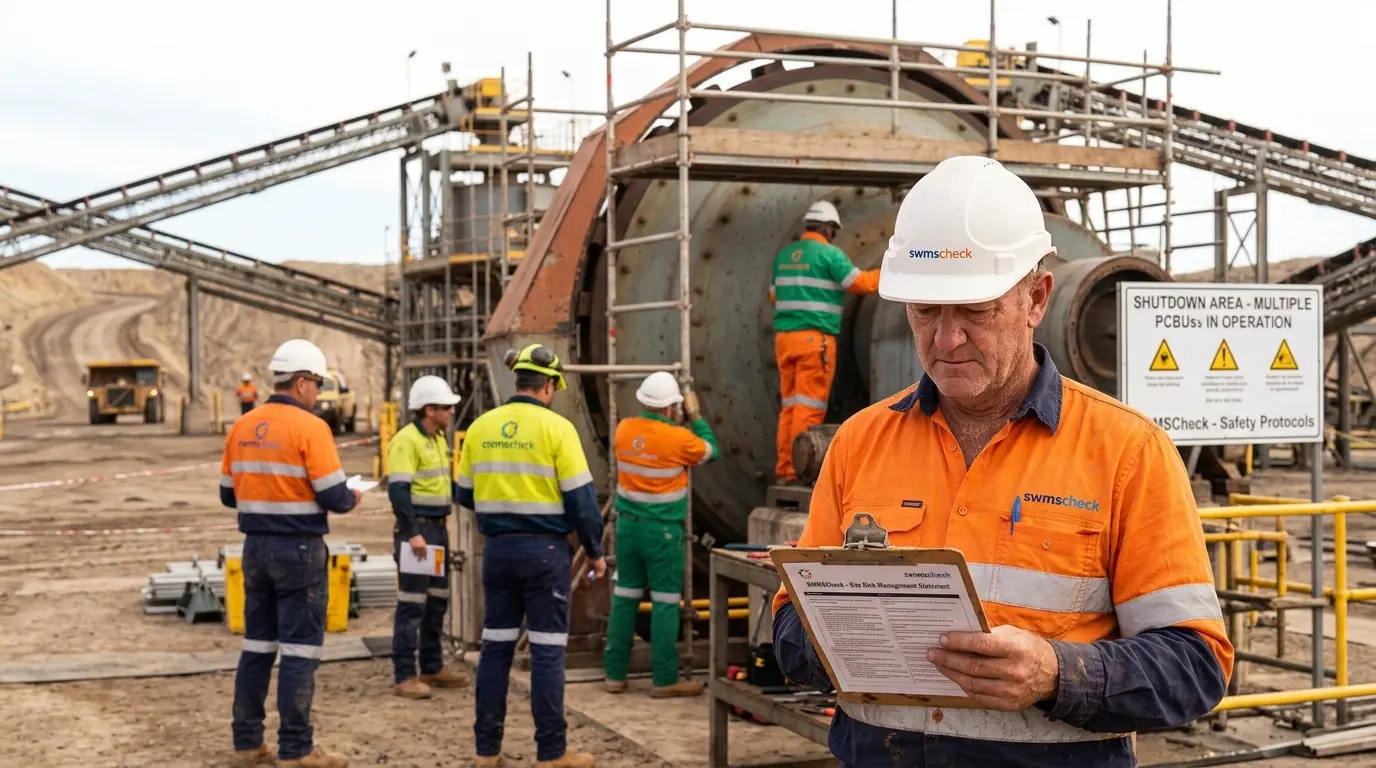
Crew's booked. Mob date's locked in. Then the SWMS comes back from the principal contractor with red pen all over it, and the job sits still while you rewrite it.
It happens all the time, and it's rarely because the work itself is unsafe. It's because the document doesn't prove the work has been planned for this site.
On a WA mine, a SWMS for high risk construction work sits under the Work Health and Safety (Mines) Regulations 2022. Regulation 299 sets out what it has to contain. Whoever reviews it for the principal contractor (PC) is checking two things: does it meet r.299, and does it fit their site. Nearly every knock-back comes down to one of the three reasons below.
It's a generic template
Downloaded from the internet, bought in a pack, or copied from the last job with the company name swapped. Everyone's done it. Reviewers can spot it fast, because the hazards don't have a place in them.
WorkSafe WA's own SWMS information sheet warns that a generic template may not meet the regulations unless it's amended for the actual workplace. It also warns that a long SWMS is harder to apply and review. A 40-page document for a two-day job isn't thorough. It's a sign nobody edited it.
How reviewers spot it
- Hazards that don't apply to the job, like "overhead powerlines" on work inside a mill building.
- The same risk rating on every line, unchanged from the template.
- Controls like "use appropriate PPE" or "follow safe work practices" that could be pasted anywhere.
- Pages and pages for a short, single-task job.
Fix it: delete every hazard that doesn't apply. Rate each risk for this job, not the template's. Cut it down until your crew would actually read it before they sign it.
Nothing in it says which site
A SWMS can have genuine, decent controls and still get bounced because it doesn't engage with the site it's going on. Under the regs, a SWMS has to take into account the circumstances at the workplace. On a construction project, it also has to fit the principal contractor's WHS management plan.
That plan isn't just paperwork for the PC. WorkSafe WA says it has to set out the site-specific health and safety rules and how SWMS will be collected, assessed, monitored and reviewed. In other words, the PC is checking your document against their rules. If yours doesn't mention them, it's going back.
On top of that, plenty of PCs require you to use their own SWMS template. That's a contract or site requirement rather than a regulatory one, but it'll still get you knocked back if you ignore it.
How reviewers spot it
- No site name, area or plant ID anywhere in the document.
- No mention of the site's permit, isolation or exclusion zone systems.
- An emergency section that just says "follow site procedures", with no muster point or contact.
- Your company template when the PC asked for theirs.
Fix it: ask the PC for the site's Safety Plan or WHS management plan before you write the SWMS, not after. Name the location and the plant. Reference their permits and isolation process by name. Get the muster point and emergency contacts from the site. Don't guess them.
Never fill site details with a guess. A made-up muster point is worse than a blank one. SWMSCheck marks genuinely site-specific gaps as highlighted fields for you to complete, rather than inventing them.
The controls have no "how"
Regulation 299 doesn't just want a list of controls. It wants the measures to control the risks and a description of how they'll be implemented, monitored and reviewed. This is where good-looking SWMS quietly fail. Three things usually go wrong.
The hierarchy is upside down
The regs require control measures to follow the hierarchy of controls: eliminate the risk if you can, then isolate it, substitute it or engineer it out, and only then lean on admin controls and PPE. A SWMS that leads with "wear a harness" before it mentions edge protection tells the reviewer the hierarchy was never considered.
Nobody's named to check it
Who confirms the controls are in place? How often? What triggers a review? The regs require a SWMS to be reviewed and revised when controls aren't working or the work changes. If your document doesn't say who's watching, it hasn't met r.299.
No sign the crew saw it
WHS law requires you to consult the workers doing the job. A SWMS with no names, no date and no sign-on sheet reads like it was written at a desk the night before. The regs also require it to be set out so the people using it can understand it, so plain language beats safety jargon.
Fix it: for every control, add one line on who checks it and when. Put elimination and engineering controls ahead of PPE. Add a consultation block with names and dates, and a sign-on sheet the crew actually signs.
What a knock-back really costs
Every resubmission burns days, not minutes. The crew waits, the mob date slips, and someone is paying for that time. If you send it out to be fixed, the bill adds up quickly.
Before you hit send: the 2-minute check
- Site, area and plant are named, and the PC is named.
- Every hazard listed actually applies to this job.
- Each risk is rated for this task, not copied.
- Controls start with elimination or engineering. PPE comes last.
- Each control says who checks it and when.
- Review triggers are written down (incident, change in work, control not working).
- Site permits, isolations and emergency details come from the site, not a guess.
- It's on the PC's template if they asked for one.
- Consultation names and dates are recorded, and the sign-on sheet is ready.
- It references the WHS (Mines) Regulations 2022, not another state's regs or the old MSI regs.
Not sure which regulations your job falls under? Read mining or construction rules: which WHS regs apply to your SWMS in WA.
Don't wait for the knock-back. Get your SWMS checked today.
Upload it now. In 60 seconds you'll know if it passes the WHS (Mines) Regulations 2022 (WA), what's wrong, and you'll get the fixed version back.
Check my SWMS now A$15. PDF, Word or a photo. Your document stays private.Common questions
Does the principal contractor have to approve my SWMS?
The regulations require you to give the principal contractor a copy before the high risk construction work starts, and the PC has duties around obtaining and monitoring it. A formal sign-off is often a site or contract requirement on top of that, so check the site's rules.
Can I use the same SWMS on every job?
Only if you review it and amend it for each site and task. WorkSafe WA warns that a generic template may not meet the regulations unless it is changed to suit the actual workplace.
How long should a SWMS be?
As short as it can be while still covering everything regulation 299 requires. WorkSafe WA notes that a long SWMS is harder to apply and review, and your crew needs to read and understand it.
Do I need a SWMS for every task?
No. A SWMS is legally required for high risk construction work. Other tasks are usually covered by a JHA, permits and a Take 5, depending on the site.
Sources
- WorkSafe WA: Safe work method statement for high risk construction work (information sheet and template)
- WorkSafe WA: Construction on a mine site
- Work Health and Safety (Mines) Regulations 2022 (WA), WA Legislation
- Safe Work Australia: Safe work method statement information sheet