The short version
- SWMS: required by law for high risk construction work (r.299). Written before you mobilise. Covers the activity.
- JHA or JSA: breaks a task into steps. Usually a site or company requirement, not named in the regulations.
- Take 5: a personal check at the workface before you start. Minutes, not pages.
- Renaming a JHA as a SWMS doesn't make it one. If the work is high risk construction work, the document has to meet r.299.
Rock up to a WA mine site and you'll be handed, asked for, or expected to fill in a pile of safety paperwork. SWMS, JHA, JSA, JSEA, Take 5, permits. Some sites use the names interchangeably, which is exactly why people end up submitting the wrong thing.
They're not the same document with different names. Each one does a different job at a different stage of the work. Here's how they fit together.
How they stack up
Think of it as zooming in. The site's plans cover everything. The SWMS covers one high risk activity. The JHA covers the steps of a task. The Take 5 covers one person, right now, at the workface.
SWMS: the one the law asks for
A Safe Work Method Statement is the only one of the three that's required by name in the regulations. On a WA mine, that's the WHS (Mines) Regulations 2022. You need one before starting any high risk construction work, as defined in r.291.
Under r.299 it has to identify the high risk construction work, spell out the hazards and risks, describe the control measures, and describe how those controls will be implemented, monitored and reviewed. It has to be written so the people using it can understand it.
A SWMS sits at activity level. It's written before mobilisation, sent to the principal contractor before the work starts (r.301), followed on the job (r.300), reviewed when things change (r.302) and kept (r.303).
Safe Work Australia classes a SWMS as an administrative control. It supports higher-order controls like edge protection or isolation. It doesn't replace them.
JHA or JSA: the step-by-step
A Job Hazard Analysis (also called a Job Safety Analysis, or a JSEA when environment is added) breaks a single task into steps and looks at the hazards and controls for each one. Pull the guard, isolate, test for dead, lift the motor, and so on.
The regulations don't name a JHA. Its role comes from the general duty to manage risk, plus the site's own system. Plenty of mines and principal contractors require one for every task, high risk or not, usually filled in by the crew at the start of the job or shift.
A JHA is more detailed than a SWMS but narrower. It sits underneath the SWMS and should never contradict it.
Take 5: the last check
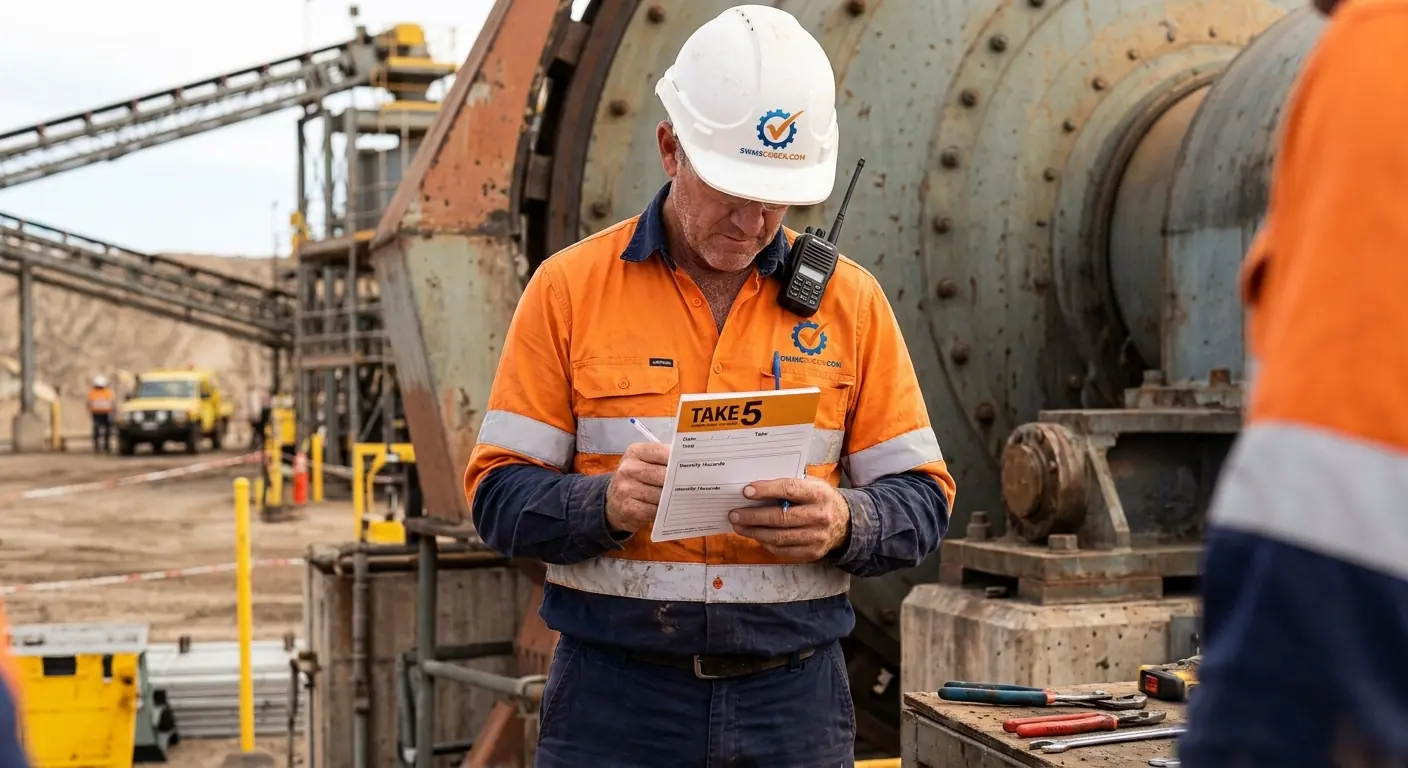
A Take 5 is a quick personal risk check done by each worker at the workface, right before they start, and again when conditions change. It's typically five steps along the lines of stop, look, assess, control and proceed. Exact wording varies by site.
It isn't a legislated document. It's a site tool that keeps people thinking about what's changed since the SWMS and JHA were written: the wind's picked up, a loader's moved in, the scaffold tag is out of date.
Side by side
| SWMS | JHA / JSA | Take 5 | |
|---|---|---|---|
| Required by law? | Yes, for high risk construction work (r.299) | Not by name. Usually a site or company requirement | No. A site tool |
| Covers | A high risk construction activity | The steps of one task | One person, at the workface |
| Written by | The PCBU doing the work, in consultation with workers | The crew doing the task, often with the supervisor | Each worker |
| When | Before mobilising and before work starts | Start of the task or shift | Right before starting, and when things change |
| Goes to | Principal contractor, before work starts (r.301) | Supervisor, kept at the job | Supervisor or site system |
| Reviewed | When controls fail or the work changes (r.302) | Each time the task is done | Every time |
| Typical length | A few pages | One to two pages | A card or a screen |
Where each one happens in a job
Can one document do all of it?
Partly. WorkSafe WA says a PCBU on a mine can meet the intent of a SWMS through one or more documents that form part of the safe system of work, as long as everything r.299 requires is demonstrated. So a combined pack can work.
What doesn't work is the reverse: calling a JHA a SWMS. If the job involves high risk construction work and the document doesn't cover what r.299 requires (the high risk work, hazards, controls, and how controls are implemented, monitored and reviewed), changing the title won't save it.
Most common mix-up: submitting a step-by-step JHA to the principal contractor when they asked for a SWMS. It has the steps but none of the monitoring, review or consultation detail, so it gets knocked back.
Which do you need?
- Is any part of the job high risk construction work under r.291? You need a SWMS.
- Does the site or PC require a JHA for every task? Most WA mines do. Check the site induction pack.
- Will you be at the workface? Expect a Take 5, every task, every person.
- Does the PC want their own template for any of these? Use it.
Not sure if your work counts as high risk construction work on a mine? Start with which WHS regs apply to your SWMS in WA.
Don't wait for the knock-back. Get your SWMS checked today.
Upload it now. In 60 seconds you'll know if it passes the WHS (Mines) Regulations 2022 (WA), what's wrong, and you'll get the fixed version back.
Check my SWMS now A$15. PDF, Word or a photo. Your document stays private.Common questions
Is a JSA the same as a SWMS?
No. A SWMS is required by the regulations for high risk construction work and must meet regulation 299. A JSA or JHA breaks a task into steps and is usually a site requirement. Calling a JSA a SWMS does not make it compliant.
Is a Take 5 a legal requirement in WA?
A Take 5 is not named in the WHS regulations. It is a site tool that many WA mines require as part of their safety system.
What's the difference between a JHA and a JSA?
In practice, most sites use them to mean the same thing: a step-by-step breakdown of a task with the hazards and controls for each step. Some sites call it a JSEA when environmental aspects are included.
Can a SWMS and a JHA be combined?
WorkSafe WA says the intent of a SWMS on a mine can be met through one or more documents forming part of the safe system of work, provided all the requirements of regulation 299 are shown.
Sources
- WorkSafe WA: Construction on a mine site
- WorkSafe WA: Safe work method statement for high risk construction work (information sheet and template)
- Work Health and Safety (Mines) Regulations 2022 (WA), WA Legislation
- Safe Work Australia: Safe work method statement information sheet